SimBench.
A framework for evaluating and diagnosing LLM‑based digital‑twin generation for multi‑physics simulation.
1 Mechanical Engineering, University of Wisconsin–Madison · 2 Computer Science, Rice University · 3 Electrical & Computer Engineering, University of Wisconsin–Madison
§ A Abstract
We introduce SimBench, a benchmark designed to evaluate the proficiency of simulator‑oriented LLMs (S‑LLMs) in generating digital twins (DTs) that can be used in simulators for virtual testing. Given a collection of S‑LLMs, this benchmark ranks them according to their ability to produce high‑quality DTs. We demonstrate this by comparing over 33 open‑ and closed‑source S‑LLMs.
Using multi‑turn interactions, SimBench employs an LLM‑as‑a‑judge (J‑LLM) that leverages both predefined rules and human‑in‑the‑loop guidance to assign scores for the DTs generated by the S‑LLM, thus providing a consistent and expert‑inspired evaluation protocol. The J‑LLM is specific to a simulator, and herein the proposed benchmarking approach is demonstrated in conjunction with the open‑source Chrono multi‑physics simulator. Chrono provided the backdrop used to assess an S‑LLM in relation to the latter’s ability to create digital twins for multibody dynamics, finite element analysis, vehicle dynamics, robotic dynamics, and sensor simulations. The proposed benchmarking principle is broadly applicable and enables the assessment of an S‑LLM’s ability to generate digital twins for other simulation packages, e.g., ANSYS, ABAQUS, OpenFOAM, StarCCM+, IsaacSim, and pyBullet.
§ 1 Framework
A judge that explains its score
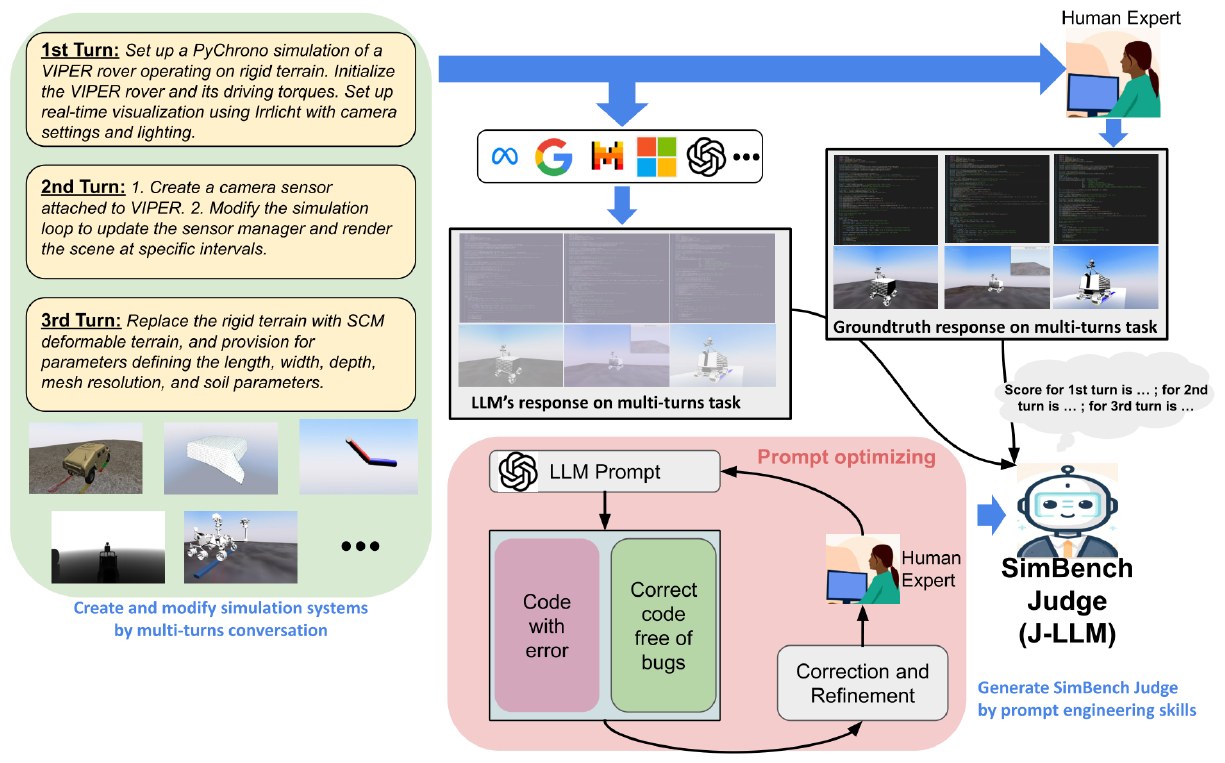
Execution metrics such as Pass@k are all‑or‑nothing: one minor defect in a simulation script yields a zero, even when the digital twin is qualitatively close to correct. Similarity metrics such as CodeBLEU and ROUGE‑L reward surface overlap rather than physics. SimBench instead calibrates a judge LLM against expert scores — once, with a human in the loop — and then uses the frozen judge to deliver a 0–100 score plus itemized diagnostics that attribute every deduction to a concrete aspect of the generated script.
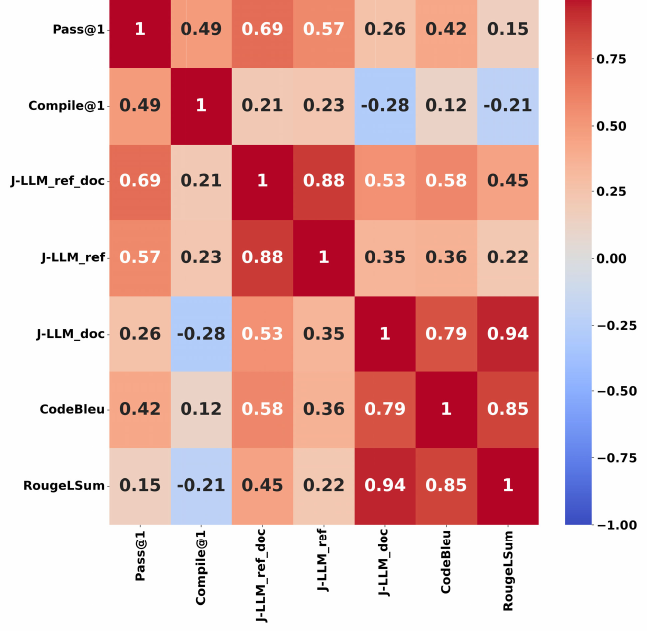
Reference script and API documentation. The headline SimBench metric — rank correlation of ρ = 0.69 with human‑assessed Pass@1, the strongest correlate of Pass@1 among all the metrics compared.
Reference script only. Stricter and cheaper; still correlates at ρ = 0.57 with Pass@1 — ahead of Compile@1 (0.49), CodeBLEU (0.42) and ROUGE‑LSUM (0.15).
Documentation only. Without a reference, the judge drifts toward surface similarity (ρ = 0.94 with ROUGE‑LSUM) — evidence that the reference script is what grounds the score in physics.
§ 2 The benchmark
Thirty-four systems, five physics regimes
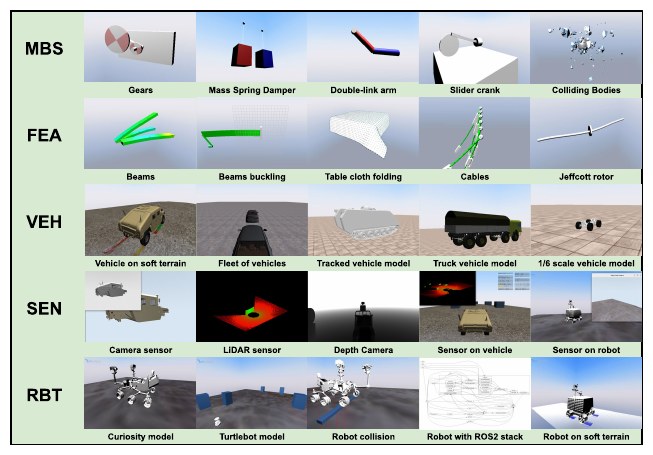
Every system ships with expert‑authored ground truth in PyChrono and a three‑turn dialogue that moves from a vague build request to a demanding extension. Tasks average 985 prompt tokens and 1,415 solution tokens — roughly 7.5× the prompt length of HumanEval and 61.6× that of MBPP.
Multibody systems
MBSRigid-body dynamics with joints, contact, collision and friction.
Finite elements
FEAFlexible beams, cables and shells; vibration, buckling, stress and strain.
Sensors
SENGPS, IMU, lidar and camera models attached to running simulations.
Vehicle dynamics
VEHFull vehicle models — driver, powertrain, tires — on rigid and deformable terrain.
Robotics
RBTRovers and mobile robots — including NASA’s VIPER and Curiosity — plus ROS bridges and deformable terrain (SCM).
Chips carry the dataset’s own system identifiers — e.g. viper is NASA’s VIPER lunar rover, scm is deformable soil‑contact terrain, hmmwv is the HMMWV military truck.
Three turns, rising difficulty
Build from scratch
Construct the digital twin from an abstract, minimally specified description — an ~87‑token prompt and nothing else.
Modify & debug
Meet concrete requirements for changing the turn‑1 script — a ~1.4k‑token prompt carrying the full previous code.
Extend the scenario
A challenging extension demanding multi‑step reasoning and coordinated changes across components.
What the judge scores
Additive deductions from 100 across six weighted dimensions — e.g. −15 for each missing essential component, −15 for API misuse that changes simulation behavior. The judge returns an itemized critique and a machine‑parsable final score.
Points at stake per dimension, out of 100.
§ 3 Results
Nobody clears fifty
Across 33 open‑ and closed‑source models, the best overall SimBench score is 49 out of 100. Reasoning models hold the top three positions, open‑weights models sit within a few points of the frontier — and the headroom above every bar is the point: generating a working digital twin from a natural‑language request is far from solved.
J‑LLM Ref+Doc score (0–100), macro-averaged over all 102 turn-level tasks — Table V of the paper. Bars are drawn against the full 0–100 scale. Scores across all 33 models range down to 21 (phi‑3‑medium‑128k).
Table view — all three judge modalities
| # | Model | Ref+Doc | Ref | Doc | Weights |
|---|---|---|---|---|---|
| 1 | claude-4-sonnet | 49 | 39 | 55 | proprietary |
| 2 | o3 | 46 | 37 | 67 | proprietary |
| 3 | claude-3.7-sonnet | 43 | 36 | 55 | proprietary |
| 4 | o4-mini | 42 | 35 | 54 | proprietary |
| 4 | qwen3-235b-a22b | 42 | 32 | 55 | open |
| 6 | gemini-2.5-pro | 41 | 31 | 62 | proprietary |
| 6 | gpt-4.1-mini | 41 | 34 | 55 | proprietary |
| 6 | gpt-4o-mini | 41 | 28 | 49 | proprietary |
| 6 | llama-4-maverick | 41 | 33 | 44 | open |
| 6 | llama-4-scout | 41 | 34 | 38 | open |
| 6 | llama-3.3-70b | 41 | 34 | 42 | open |
| … | 21 further models | ≤40 | |||
| 33 | phi-3-medium-128k | 21 | 20 | 20 | open |
The ceiling is low
The best overall score in the study, from claude‑4‑sonnet. Digital‑twin generation remains an open problem.
Few scripts truly run
Best Pass@1 in the human‑assessed 19‑model subset: even the strongest model produces a functionally passing script about once in eight attempts.
Code context is decisive
Mean turn‑2 gain once the model sees its own previous script plus sharp requirements — 87.6% of the 1,122 model–system pairs improve.
Extensions break twins
Systems whose scores drop again at turn 3 (mean −6.2), where the request demands multi‑step, cross‑component changes.
Sensors are hardest
Lowest category average; the single hardest system is lidar at 23.4. FEA is the most tractable category at 41.0.
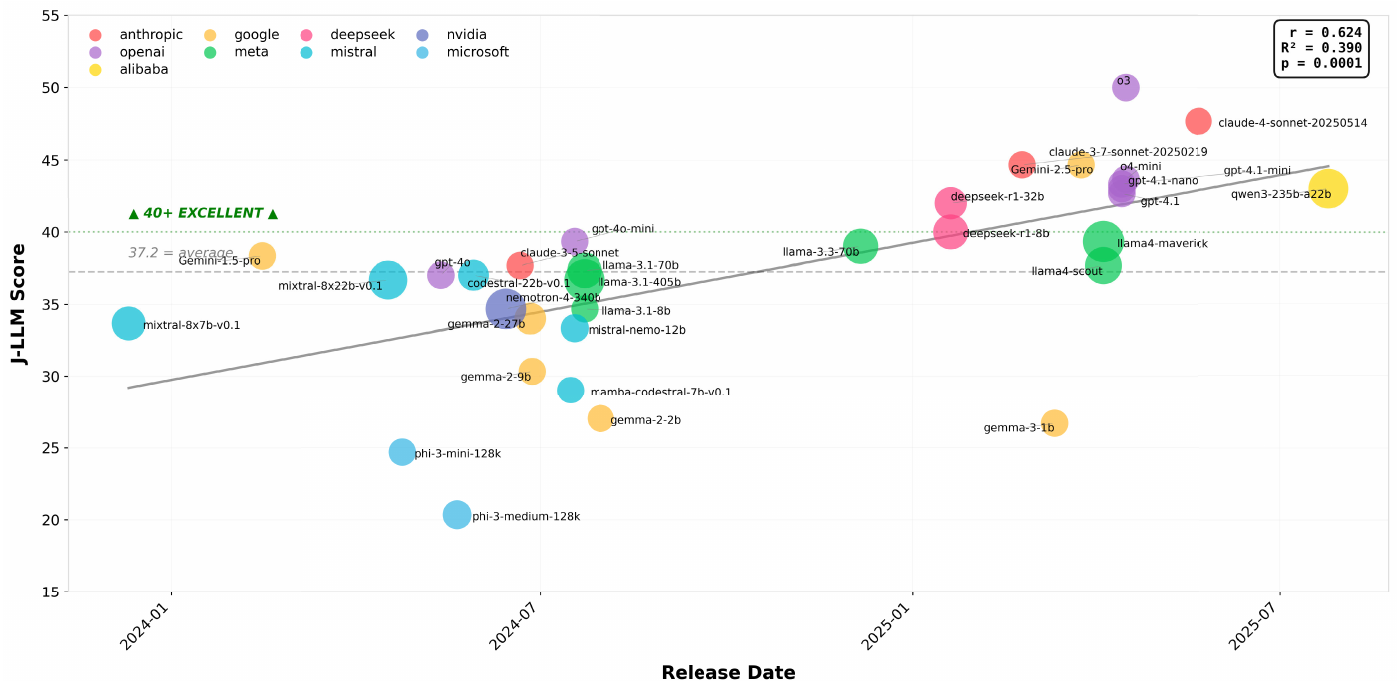
Models are improving
Correlation between release date and the average judge score across the three modalities (p < 0.001). Reasoning‑enabled models hold the top three positions.
§ 4 Get started
Score your own model
The repository ships the full benchmark — 34 systems × 3 turns with ground truth — plus the calibrated judge as both a CLI and a library. The judge defaults to gpt‑4o‑mini; any OpenAI‑compatible provider works via --base-url.
# environment
$ conda env create -f environment.yml
$ conda activate chronobench
$ export OPENAI_API_KEY=sk-...

# score your agent (34 systems × 3 turns)
$ python -m chronobench.score <your-agent> \
      --responses-dir runs --dry-run
$ python -m chronobench.score <your-agent> \
      --responses-dir runs

# reproduce the published evaluation
$ bash scripts/fetch_published_data.sh
$ python scoring/rank_llm.py
from chronobench.judge import evaluate_script

ev = evaluate_script(
    candidate_code,
    reference=truth_code,
    api_doc=open("api/api.txt").read(),
)

print(ev.score)      # 0–100
print(ev.rationale)  # itemized deductions —
                     # feed them back to your agent
The main branch moves beyond the paper (leaner dependencies, test suite). For the exact published pipeline and data, check out tag paper-ieee-access-2026; the frozen run itself is archived on Zenodo.
§ 5 Beyond Chrono
A simulator-agnostic recipe
SimBench is demonstrated on Chrono, but the benchmarking principle is portable: given an expert dataset for another ecosystem, the same workflow yields a calibrated judge for it. Porting means re‑instantiating three interface points.
What does the simulator consume?
Recast the multi‑turn protocol around the native artifact — Python scripts, input decks, XML/URDF/SDF models, or plugin code.
What grounds the judge?
API documentation plus expert reference solutions, used to calibrate the judge for the new ecosystem before freezing it.
What counts as running?
Platform‑specific compile and pass checks — an Abaqus job that submits, a MuJoCo rollout with no NaNs and bounded trajectory error.
Companion benchmark — PyChronoBench
280 auto‑gradable multiple‑choice questions probing fine‑grained PyChrono API knowledge — contact modeling, body creation, solver settings, sensor configuration. A fast complement to SimBench’s full generation tasks.
§ 6 Citation
Cite this work
@article{simbench2026,
  author  = {Wang, Jingquan and Negrut, Andrew and Wang, Hongyu
             and Zhang, Harry and Negrut, Dan},
  journal = {IEEE Access},
  title   = {SimBench: A Framework for Evaluating and Diagnosing
             LLM-Based Digital-Twin Generation for Multi-Physics
             Simulation},
  year    = {2026},
  volume  = {14},
  pages   = {61784-61808},
  doi     = {10.1109/ACCESS.2026.3685519}
}